«FOUR DIAMONDS OF INDIA»
Namaste!
 Your guide, Jayant (also known as Albert; born in Russia under name Albert), lives in India and Nepal. Professional traveler, visited 40 countries, organized and participated in an around-the-world expedition «Hat Master-2014». Has 25+ years of experience in tourism. He is educated in arts, biology, geology and cultural science. Practices yoga since 16 years old, is a student of Indian spiritual Guru Swami Prem Samdarshi (spiritual knowledge of Osho transition line).
Duration: 15 days / 14 nights
Travel type: pilgrimage to holy places, excursions, trekking in mountains
Dates: 7. October — 21. October 2023
Price for one traveler: $1334
Spiritual journey to the heart of Indian Himalayas, to the most sacral places, filled with inexhaustible life-giving energy of the Creator! We will look at four relics of Himalayas. Hindu followers consider pilgrimage (Yātrā) to them a big spiritual achievement and a glorious blessing of gods.
Along mountain serpentine roads we will travel to the most revered temples of Northern India in Badrinath, Kedarnath, Gangotri and Yamunotri, reach headwaters of sacred Ganges and Yamuna rivers, splendid «Valley of flowers» and in the cave where sage Veda Vyāsa wrote Vedas texts — purāṇa and «Mahabharata» epic! During this difficult trip we’re all going to meet our true inner self, go through serious spiritual work, trials and tribulations, through which goes everyone, who’s ready to tap into Higher Knowledge.
This Yātrā (pilgrimage) is for spiritual seekers, it’ll change your life completely!

Route plan:
Rishikesh — Haridwar — Kunjapuri — Devaprayāg — Joshimath — Badrinath — Govindghat — Gaurikund — Kedarnath — Gangotri — Barkot — Yamunotri — Dehradun — Rishikesh
Essential Hindu relics and sights on the route:
— Vishnu temple in Badrinath,
— Shiva temple in Kedarnath,
— Goddess Gaṅgā temple in Gangotri,
— Goddess Yamuna temple in Yamunotri,
— Gaumukh glacier in Gangotri, Ganges headwaters,
— Yamunotri, Yamuna river headwaters,
— «Valley of flowers» in Himalayas,
— Hemkund high altitude lake and gurduārā,
— Yoga-Vāsiṣṭha cave,
— Veda Vyāsa cave,
— Sri Gaṇeśa cave,
— Gaurikund temple and sacred hot springs,
— Maharishi Mahesh Yogi ashram in Rishikesh,
— Gaṅgā Aarti — «fire» puja on Ganges,
— Kunjapuri temple on top of the mountains,
— raft trip along Ganges,
— Har Ki Pauri ghat in Haridwar,
— Mansa Devi temple, Haridwar,
— Shiva Mūrti gigantean statue, Haridwar,
— Sri Rama temple in Devaprayāg,
— Shankara monastery and «Lingam of Light», Joshimath,
— Shivaling peak near the Ganges headwaters,
—Nilkantha mountain, «Queen of Himalayas»,
—Lord Vishnu’s footprint near Badrinath.
*Participating in this journey is contraindicated for people who suffer from heart diseases and musculoskeletal system disorders, susceptible to motion sickness syndrome. Big part of our route lies in mountains, 1500 to 4300 meters high, along winding, in some places extreme, serpentine roads.
Trip program
Day 1
Delhi-Rishikesh
Upon arrival to Delhi with the «Aeroflot» morning flight you’ll transfer within single Т-3 terminal to «Air India» morning flight bound for Dehradun.
The flight takes only 50 minutes. In Dehradun «Jolly Grant» airport your guide will meet you and organize the transfer to the hotel so that you can rest after last night’s flight.
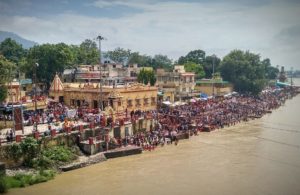
After having dinner in a traditional Hindoo restaurant we’ll start our guided tour around the city, including visiting Lakshman Jhula tourist district, river fronts (ghats) of Ram Jhula district, abandoned ashram of Maharishi Mahesh Yogi, where «The Beatles» band members came to study the art of Yoga and meditation in their time.

In the evening we will participate in traditional Gaṅgā Aarti, fire puja to honor Goddess Gaṅgā Devi on the Parmarth Niketan temple ghat.
Dinner, overnight at the hotel.
Day 2
Rishikesh — Kunjapuri — Rishikesh
We will get up long before sunrise. Car will raise us high on the uphill serpentine road in the mountains, to the top of Kunjapuri. There is a specially revered temple of Shiva and Sati of the same name, Kunjapuri.
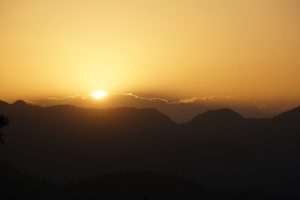
From here the great view on Big Himalayas opens. We will see peaks of the highest mountains on Earth covered with eternal snows. But that is not all! We will also witness the Sun rise over Himalayas! In the temple we’ll be able to get blessing of Shiva, patron of yogins, muni (ascetic) and mountains.

During this day we will make an unforgettable 15-km long raft trip along Ganges: sea of adrenaline, high waves, turquoise color waters, cliffs, waterfalls, riffles and rapids. Brave ones may jump down from a 7-meters high cliff (wearing a life-jacket and a safety helmet, of course).

In the evening we will participate in Gaṅgā Aarti near the temple of Shiva, on Lakshman Jhula. We will be direct participants of this colorful many thousands years old ceremony.
Night in the hotel.
Day 3
Rishikesh — Haridwar — Rishikesh
This day we spend in Haridwar. There we take ritual bathing in Ganges waters at Har Ki Pauri («footsteps of the Lord Shiva»), city’s main Ghat, along with thousands of pilgrims.

According to legend, plunging in this sacred river, people wash all sins and misfortunes away from themselves and get rid of illnesses. Vedas texts also have it that in this very place Gods and demons dropped some droplets of Amrita immortality nectar they obtained from the Ocean of Milk. Since then Haridwar became the place of massive pilgrimage for Hindu religion followers and one of 4 places where Kumbha Mela, the most massive religious festival in the world, is held.
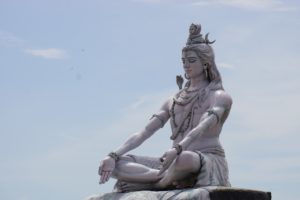
We will visit Mansa Devi temple, sitting on top of the mountains and see colossal statue of Shiva Murti (Haridwar patron). In the evening, after we return to Rishikesh, it’s time for tasty supper in a little restaurant with a view to Ganges.
Night in the hotel.
Day 4
Rishikesh – Devaprayāg – Joshimath
Get ready for a long way in a Jeep through mountain serpentine roads, among shockingly beautiful Himalayas scenery. The road zigzags and takes us higher and higher into mountains, but gorgeous Ganges is always near, its turquoise waters draw the eye.
We will visit a sacred place — Yoga-Vāsiṣṭha cave, go in for meditation, where the teacher of Gods, an eternal yogi (rishi) practiced ascesis during immemorial Vedic times.

Picturesque Devaprayāg town, where Bhagirathi and Alaknanda rivers merge, awaits for us. This is the place where Ganges starts!
We will make a traditional worship of Mother Ganges, get a blessing from holy people of Sadhu, who will read a special mantra, give their blessing to you and your close ones. In the evening we arrive at Joshimath, the former capital of the mountainous Garhwal Kingdom.
Night in the hotel.
Day 5
Joshimath — Badrinath — Mana
In the morning we will visit Shankara monastery, containing «Lingam of Light». As legend has it, it was handed over to saint by Lord Shiva himself, patron of Himalayas. In the Narasiṃha temple an unusual statue is kept. According to legend, thinning one of its hands will be a sign of last cycle of times’ start before the Great Destruction of the Universe.

We continue our journey to the «eternal» Badrinath city, one of the most significant religious pilgrimage centers in India. These lands are surrounded by many mysteries. Great saints and eternal yogins made pilgrimage here.

Our goal is Badrinath temple where 15 Hindu deities (Mūrti), made of black stone, are set. Before entering the temple it is necessary to make ablution in the sacred hot sulphur springs. After Sri Badrinath darshan we will ascend by walking track in the mountains to see the panorama this picturesque pilgrims’ town from a birds eye view.
After walking a little further, we visit sacred stone situated in an intermountain valley. This stone keeps Lord Vishnu’s footprint.

In the village of Mana, not far from Badrinath, near Tibetan border, we’ll go inside two caves. Legend has it, inside them the sage Veda Vyāsa wrote 18 purāṇa and «Mahabharata» epic. In his work on the texts Sri Dvaipāyana Vyāsa was assisted by Lord Gaṇeśa.

We return to Badrinath and spend the following night in the hotel.
Day 6
Badrinath — Govindghat — Ghangaria
After breakfast we head to Govindghat settlement, situated on Alaknanda river. From here our long 14-km long ascent up the equipped mountain path starts. At the end of it we reach Ghangaria village.
This distance we will cover mounted on horses. Settling in the hotel, having dinner, we’ll mount horses again and head high into the mountains, to the sacred Hemkund lake, 4340 meters high.

Sikh Guru Gobind Singh states in his book « Granth Sāhib » that in his previous life he practiced meditation on this lake’s shore, surrounded by seven mountain peaks. Hemkund lake shore is generally thought to be that very place. Big gurduārā (Sikh temple) and Hindu Lakshman (Lord Rama’s younger brother) temple are erected here. It is generally thought, that on the shore of this lake Lakshman practiced meditation and recovered his health after a bad wound that Meghnath, son of demon Ravana, inflicted on him.
Night in the hotel.
Day 7
Ghangaria — «Valley of flowers» — Joshinath
After early breakfast we walk by foot along the mountain path to the «Valley of flowers» National park.

Located more than 4000 meters high, this valley is where big number of flowering plants species grows. Equipped promenade track inside the National park is 8 kilometers long.

You will see the beauty of Himalayas’ pristine wilderness: mountain rivers, cascades of waterfalls, glaciers, snowy peaks and, of course, countless flowers!
After return to Ghangaria and dinner we start our slope to Govindghat, mounted on horses. There we will get into a car and drive for 30 kilometers to already familiar Joshinath.
Night in the hotel.
Day 8
Joshinath – Gaurikund
In the morning we will head to the next pilgrims’ center of Hindu religion followers – Gaurikund. Legend has it that here Gurimata (Parvati) was born and practiced ascesis (spiritual practices of renunciation) for hundreds of years to get married to Shiva.

Here you should take ablution in the hot thermal sulphur spring. It is believed to be located in the very spot, where Parvati ascesis’ took place. Not far from there is the Gauri Devi temple. Also near is Syrkata Gaṇeśa temple. Skanda Purāṇa states that right in this place Lord Shiva beheaded his son Gaṇeśa, after which stuck an elephants’ head to his body. As stated in purāṇa, Gaṇeśa was protecting his mother Parvati, who was bathing in Gaurikund. When Shiva arrived, Gaṇeśa didn’t let him through to Parvati. Shiva didn’t recognize his own son, got angry and cut Gaṇeśa’s head off. When Parvati learned about it, she asked Shiva to bring her son back to life and give him another head.

Shiva agreed to grant the head of first living creature he would meet, which turned out to be an elephant. This is how Gaṇeśa got elephant’s head. We will enjoy the beautiful mountain scenery of this place, enjoy bathing in thermal sulphur spring. For the night we’ll stay in a pilgrims’ lodge.
Day 9
Gaurikund — Kedarnath — Gaurikund
Early in the morning we will visit puja (religious service) in Gauri Devi temple and get Goddess’ darshan (blessing). After that we will start ascension to an especially revered temple of Lord Shiva, situated at the bottom of Kedarnath peak, 3600 meters high. It is one of the most important Hindu sacred pilgrimage places in Indian Himalayas.
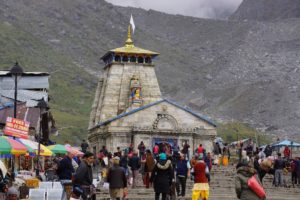
Temple was built in VII century AD near headwaters of the Mandakini River, a tributary of the Alaknanda River, by a Hindu Guru Sri Shankaracarya. It sits in place, where, according to legend, Shiva penetrated earth disguised as a sacred bull, leaving just a «hunch» on the surface, a self-manifested Shivalingam (symbol God Shiva).
Distance to the temple – 18 kilometers, total elevation — more than 1500 meters. If it will prove too difficult for you to walk all this way, a horse can be hired for additional $32. Having reached the temple, we receive darshan (blessing) of Lord Shiva, we will have a possibility to touch one of the main Hindu’ relics of India. Way back to Gaurikund will not be big trouble – it usually takes 3 to 3,5 hours.
We will once again bathe in a kunda (sulphur spring) to wash away weariness from the long ascend into the mountains.
Supper, night in the lodge.
Day 10
Gaurikund – Gangotri
Long, picturesque road awaits us among majestic Himalayas’ outskirts, up to 3753 meters high. Gangotri village is our next stop, not far from the Ganges river headwaters, called Bhagirathi before merging with the tributary Alaknanda River.

Gangotri is the residence of Goddess Gaṅgā Devi. It is one of the biggest pilgrims’ centers for Hindu religion followers. We will visit evening puja in the temple, dedicated to Gaṅgā, which was built in the beginning of XVIII century by the chief of the Gurkha commanders in Garhwal. Golden statue Goddess shines so brightly, it is impossible to distinguish her traits.
Night in the hotel.
Day 11
Gangotri – Gaumukh (Ganges headwaters)
Having received special permit on the previous evening, early in the morning we start to the headwaters of the most sacred rivet in India.

Scenic mountain’ trail rises by an acclivity into the mountains and takes us higher and higher into the Himalayas. Soon we shall see snowy mountain peaks of the Big Himalayas in the distance! Usually this 18 kilometers distance is covered in 4 hours, but we can also hire a herder with a horse (for additional $30 payment).
Other-worldly beauty and vibes of these lands are beyond description; the higher we rise into the mountains — the more picturesque and beautiful the scenery grows. Last 4 kilometers we have to walk because using wheel transport is forbidden there.

Descending to the gigantic Gangotri glacier, lower part of which the Hindu call Gaumukh («cow’s head»), we will find ourselves surrounded by majestic mountain peaks. The most unusual among them is Shivaling peak, a little short of 7000 meters high. Ganges (Bhagirathi) bursts out from the ice cave, located at the baseline of the glacier, as powerful, mad torrent. All around are bare stones, glacial clays and mountains. Only a tiny temple dedicated to Shiva reminds about human civilization.
Pilgrims are instructed to perform ablutions in the waters of newborn Ganges. But it must be done with great caution and only on the shore, because river current is too strong, and the water is ice cold.
During second half of the day we will gradually travel down back to the Gangotri village and dedicate the evening to rest.
Night in the hotel.
Day 12
Gangotri — Uttarkashi — Barkot
After breakfast we take a little walk to Surya Kund waterfalls.
This is a sacred place. According to Skanda Purāṇa, here Lord Shiva put his head under the powerful stream of heavenly Ganges. Since then it flows through Mahā-deva hair, outpours on Earth in form of a mountain river. It also says that the first rays of the rising sun (Surya), reflecting in the kunda, illuminated the whole world.

We will also visit a sacred cave, hidden among conifer forest, where Pāṇḍava brothers stayed on their way to Kedarnath and Badrinath before devoting themselves to ascesis and leaving this planet. Arjuna, a friend of Krishna, was one of Pāṇḍavas. Dialogues between these two are the basis for the main Hindu book — «Bhagavad-gītā».

We start on a long road to Himalayas, slope along the bed of Bhagirathi river, and then another ascent high in the mountains, to the watershed between two most sacred rivers of India — Bhagirathi (Ganges) and Yamuna.
After our descent to Yamuna shore is over, we’ll make overnight stop in the town of Barkot.
Night in the hotel.
Day 13
Barkot — Janki Chatti — Yamunotri — Barkot
After breakfast, we ride off along the narrow mountain trail, winding through the Himalayas slopes along Yamuna river bed. Time on route to the village and pilgrims’ Janki Chatti is about 3 hours. After arriving on location, we walk on foot to the Goddess Yamuna temple, located high in mountains, not far from Yamuna river headwaters. Quite an exhausting 5-km long ascent is done in about an hour and a half.

Pilgrims are instructed to make ablution in a hot spring equipped for bathing before visiting the temple. The temple is really tiny. Its relics are the statues of Yamuna and Gaṅgā Goddesses. According to Vedas, Yamuna (as Yami) is a twin-sister to Yama, God of death. The Hindus believe swimming in the waters of this river rids one from dangerous illnesses and painful death. After visiting the temple, we will dine in a tiny restaurant and start our way back to Janki Chatti, which usually takes not more than 1 hour.

In the evening we arrive by car to Barkot and rest after the eventful day, filled with unbelievable sacred beauty of these lands.
Overnight in hotel.
Day 14
Barkot — Rishikesh
We return to cozy Rishikesh, time en route — about 6-7 hours, settle at the hotel and have a rest after the long road, savouring received impressions.

In the evening we participate in Gaṅgā Aarti, thanking beautiful Goddess and the God Shiva for an opportunity to make this unforgettable pilgrimage «Char Dham», to 4 Hindu relics, situated high in the Himalayas!
Overnight in hotel.
Day 15
Rishikesh — Delhi
Today is our reserve day and a day of rest! It will be a pleasure to spend some quality time before the evening flight to Delhi, and we’re sure to have just enough. For example, repeat 15-km long rafting down the white waters of beautiful Ganges (for an additional fee of about $15)! This entertainment is the most popular in Rishikesh.
Near the city there are also some wonderful beaches with small quartz sand of white color. Remember, water constitution in Ganges is unique – it destroys almost all pathologic microorganisms, grants strength and health.

On an out of town deserted beach you may practice yoga and meditation, your guide will help you with it. After such an eventful and busy journey, before flights home, another rest near the sacred river will come in handy. In the evening we will sign out from the hotel and ride to the Dehradun airport. This is where you say farewell to your guide and head to Delhi, where you transfer within one terminal to your flight home.
Price includes:
— Airport arrival and departure accompaniment, transfers to/from the hotel;
— Hotel assignment (two-place), one-place possible for an additional fee (must be counted beforehand);
— English speaking tour guide;
— All cark transfers on route;
— Gangotri National park one time entry permit;
— «Valley of flowers» National park entry permit;
— Entrance fee to «The Beatles Ashram».
Price does not include:
— Plane tickets Delhi and back;
— Delhi — Dehradun — Delhi plane tickets, about $80;
— Health insurance card for going abroad
— Meals — $10-15 per day;
— tips to driver and porters (if necessary);
— donation (voluntary contribution) for temples and ashrams;
— Personal expenditures (buying personal hiking outfit, souvenirs etc.)
For additional payments:
— one-place assignment in hotels and lodges (discussed beforehand, calculated personally);
— mule/horse on Govindghat-Ghangaria trek, 15 kilometers — about $30 (one-way trip price);
— mule/horse on trek to Kedarnath temple, 18 kilometers — $33 (one-way trip price),
— mule/horse on trek to Gangotri glacier, 15 kilometers — $30 (one-way trip price)
— mule/horse on trek to Yamuna Devi temple, 5 kilometers — $10 (one-way trip price).
Booking order:
— Book and pay for international flights to and from Delhi;
— Book and pay for inner flights Delhi-Dehradun-Delhi;
— Down payment 35% of tour cost;
— Complete payment — to the guide on the first day of the trip (in USD).